Investment Case
Three milestones determine whether project value becomes shareholder value.
A project-stage valuation framework
Canada Nickel is still a pre-revenue developer. The near-term question is whether Crawford can progress from federal approval to final permits, committed financing, a final investment decision and construction. Conventional P/E analysis is therefore inappropriate; our primary framework is a risk-adjusted version of the project's post-tax NPV.
Our base risk-adjusted NAV is C$4.20 per share, versus a C$1.66 reference price. The model indicates BUY, but the rating remains subject to analyst approval because the 35% project-stage factor and 95% effective ownership are judgement calls with no observed-probability basis.
The financing path is the most important source of downside, including cost, dilution, retained ownership and whether committed funding arrives in time to protect the current 2029 first-production schedule. The next quarter's accounting loss carries less weight.
Sources: July 2026 investor presentation | Q2 2026 MD&A
What Is Priced In
The share price sits below our bear rNAV; the three published scenarios do not fully bound financing failure.
What the current price appears to discount
At C$1.66, the market is trading below even our C$1.79 bear value. That does not prove mispricing: the bear case still gives Crawford a 20% stage factor and 90% effective ownership. A more severe financing failure, a material capex reset or a long delay could justify a lower value.
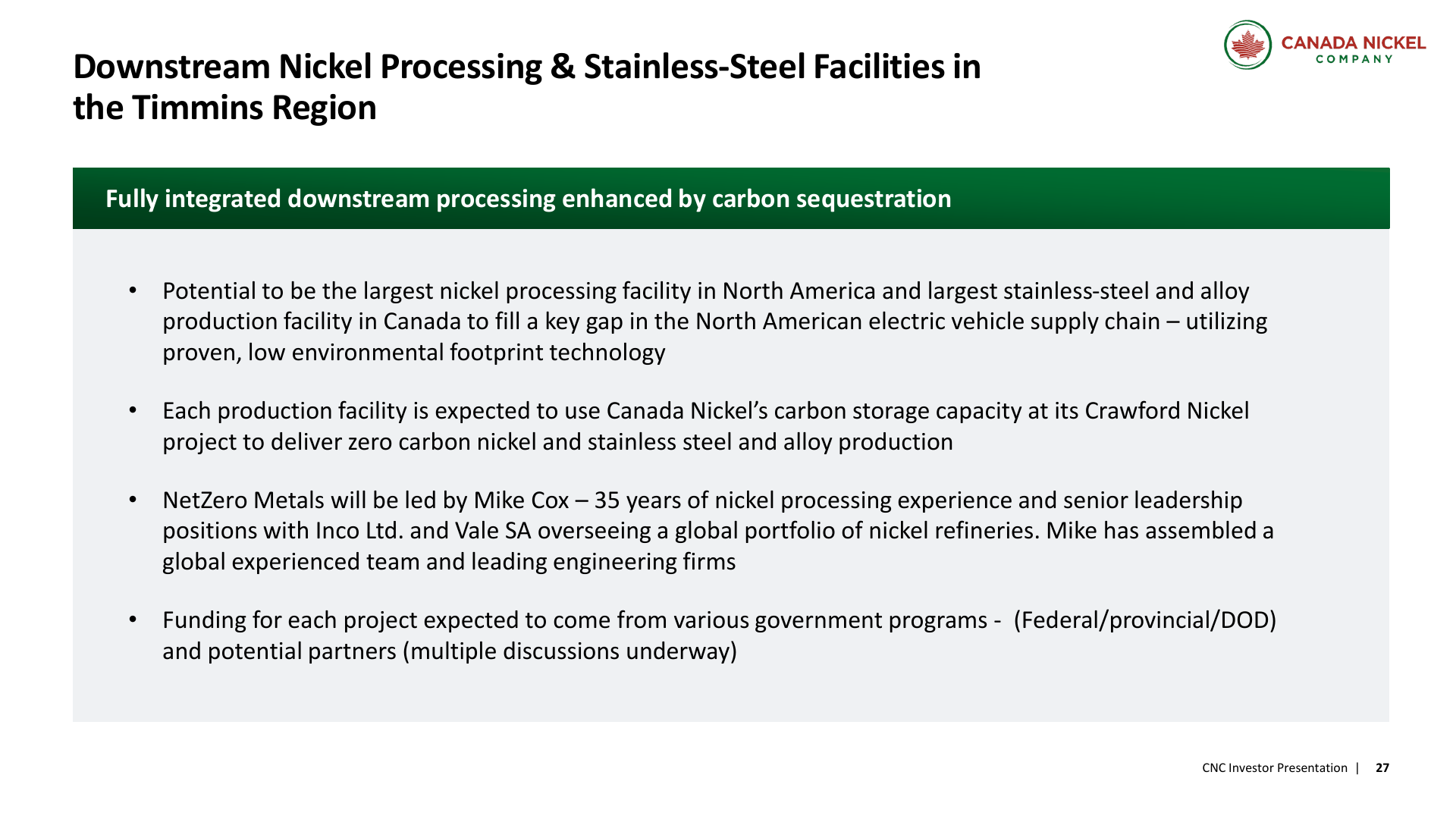
The base case deliberately assigns no value to Reid, the other Timmins deposits, downstream NetZero facilities or geologic hydrogen. Those projects remain visible in the digital twin as optionality. Their inclusion in the target price awaits an economic study or binding commercial structure that supports a separate value.
This creates an asymmetric-looking valuation, but the asymmetry is model-driven. It depends on the technical-study NPV, FX, stage factor and dilution assumptions. The sensitivity grid is more informative than a single target price.
Sources: Crawford feasibility study | July 2026 investor presentation
Company System and Digital Twin
The graph separates assets, commercial relationships and execution dependencies, then maps each path to a financial compartment.
How the company system fits together
Crawford is the economic centre of the company twin. Permitting, financing, power and engineering feed into the construction path; construction unlocks nickel concentrate; concentrate links the project to stainless steel and battery end markets.
Samsung SDI is relevant through investment and offtake rights. RWE is relevant to commercialization of low-carbon steel inputs. Hydro One is an enabling infrastructure counterparty. EDC is a financing channel. Their distinct financial roles require separate treatment.
The multi-hop view also makes negative evidence visible. A nickel-price shock changes project NPV before it changes reported Revenue, while a Reid drilling update expands geological evidence without changing our Crawford base value.
Sources: July 2026 investor presentation | Crawford feasibility study
Nickel Market
A 10% long-term nickel-price move changes project NPV by roughly US$506m.
A commodity call still sits beneath the project call
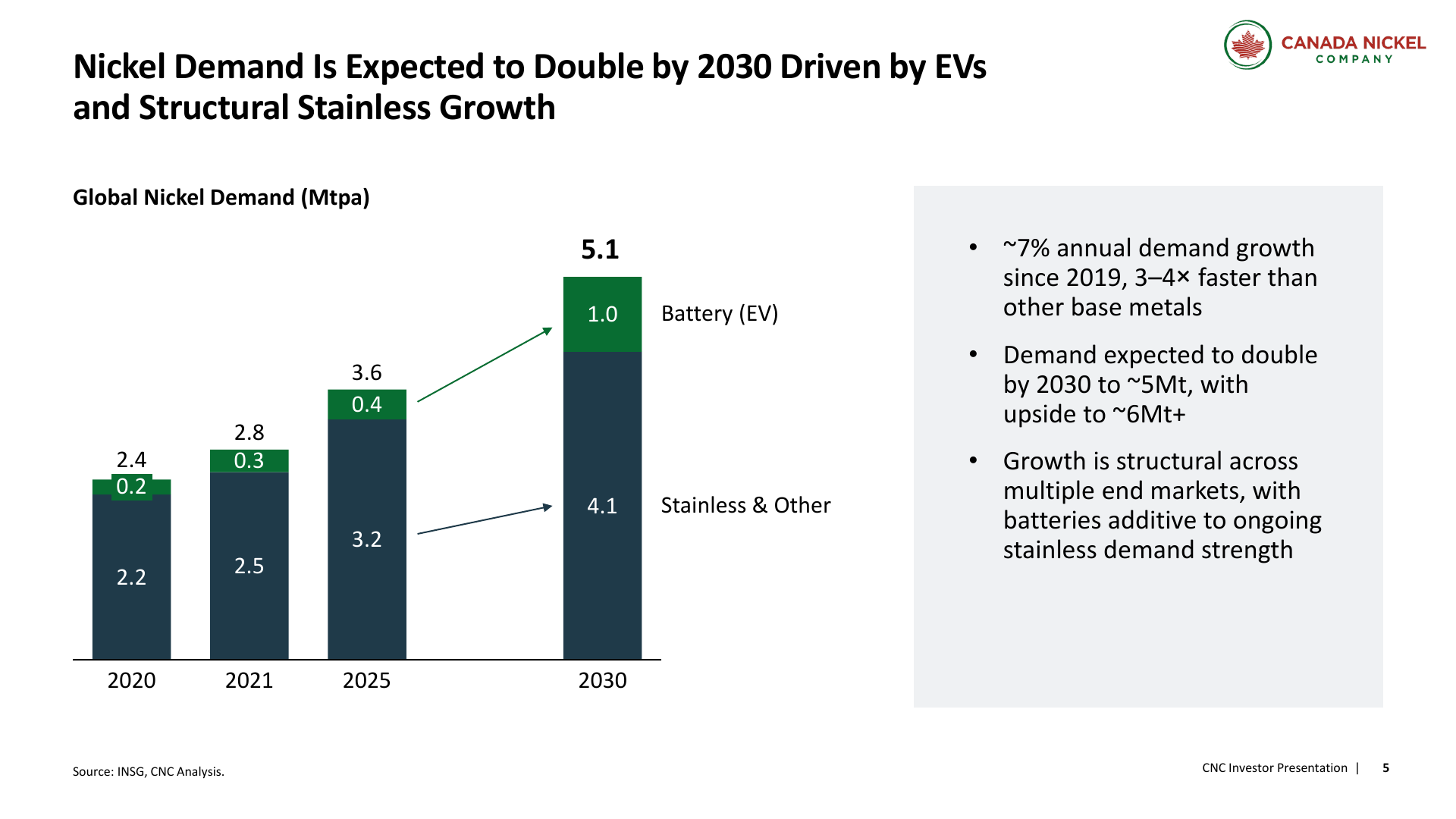
Crawford's feasibility economics use a long-term nickel price of US$21,000 per tonne and 91% concentrate payability. The technical study indicates that a 10% nickel-price move changes post-tax NPV by approximately US$506m. We apply that published sensitivity; a precise long-dated nickel forecast is not defensible at this stage.
The issuer argues that demand growth, stainless-steel consumption and constrained Western supply support new sulphide projects. That view may be directionally reasonable. Management's market slides are not independent commodity research.
Our bear and bull cases move long-term nickel by minus and plus 10%. Spot-price rallies or falls are monitored as events. Their occurrence does not automatically rewrite the frozen long-term assumption.
Sources: Crawford feasibility study | July 2026 investor presentation
Crawford Project
A large, long-life project with published first-quartile cost ambitions and substantial pre-production execution risk.
Scale is established; execution remains ahead
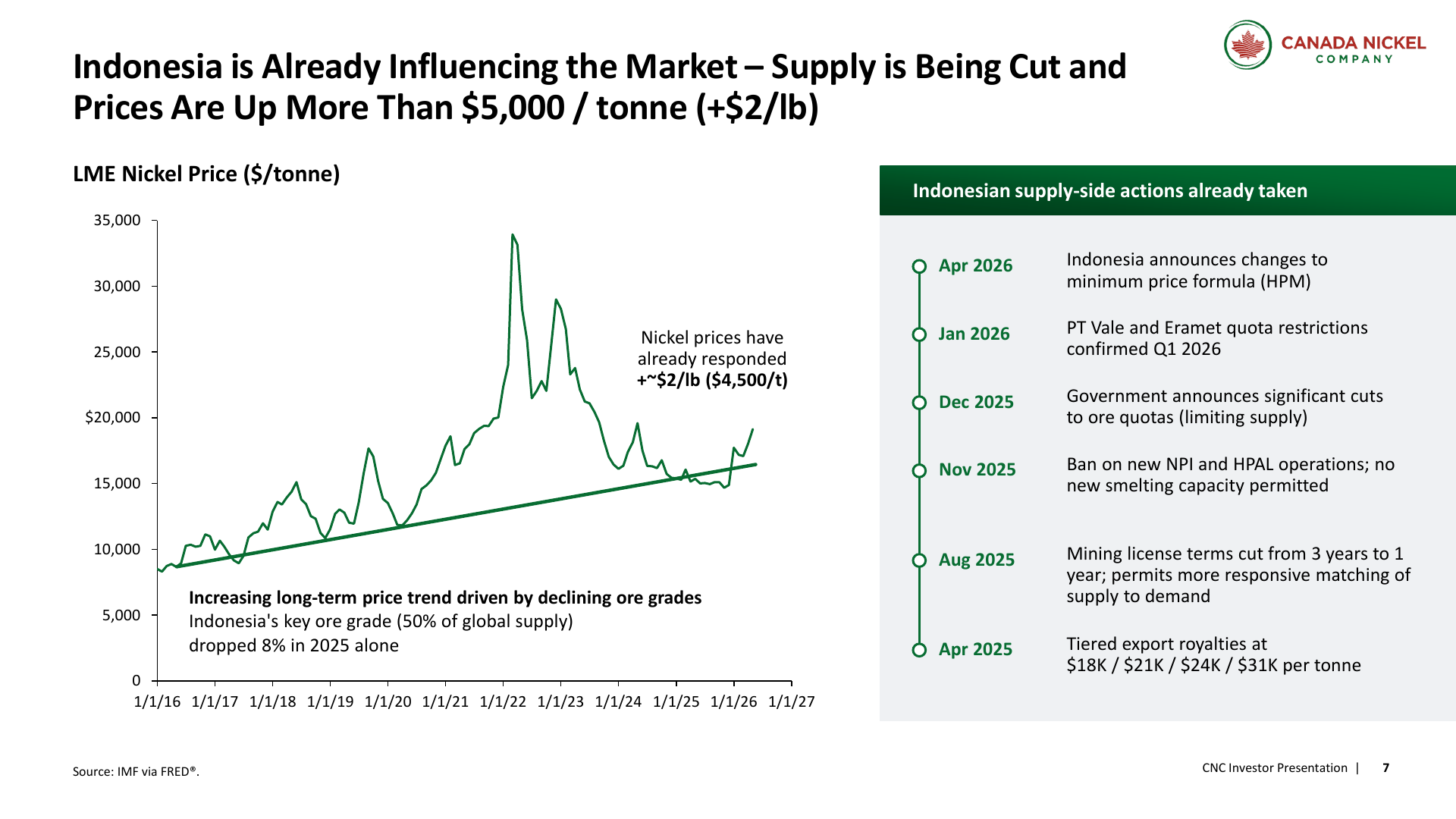
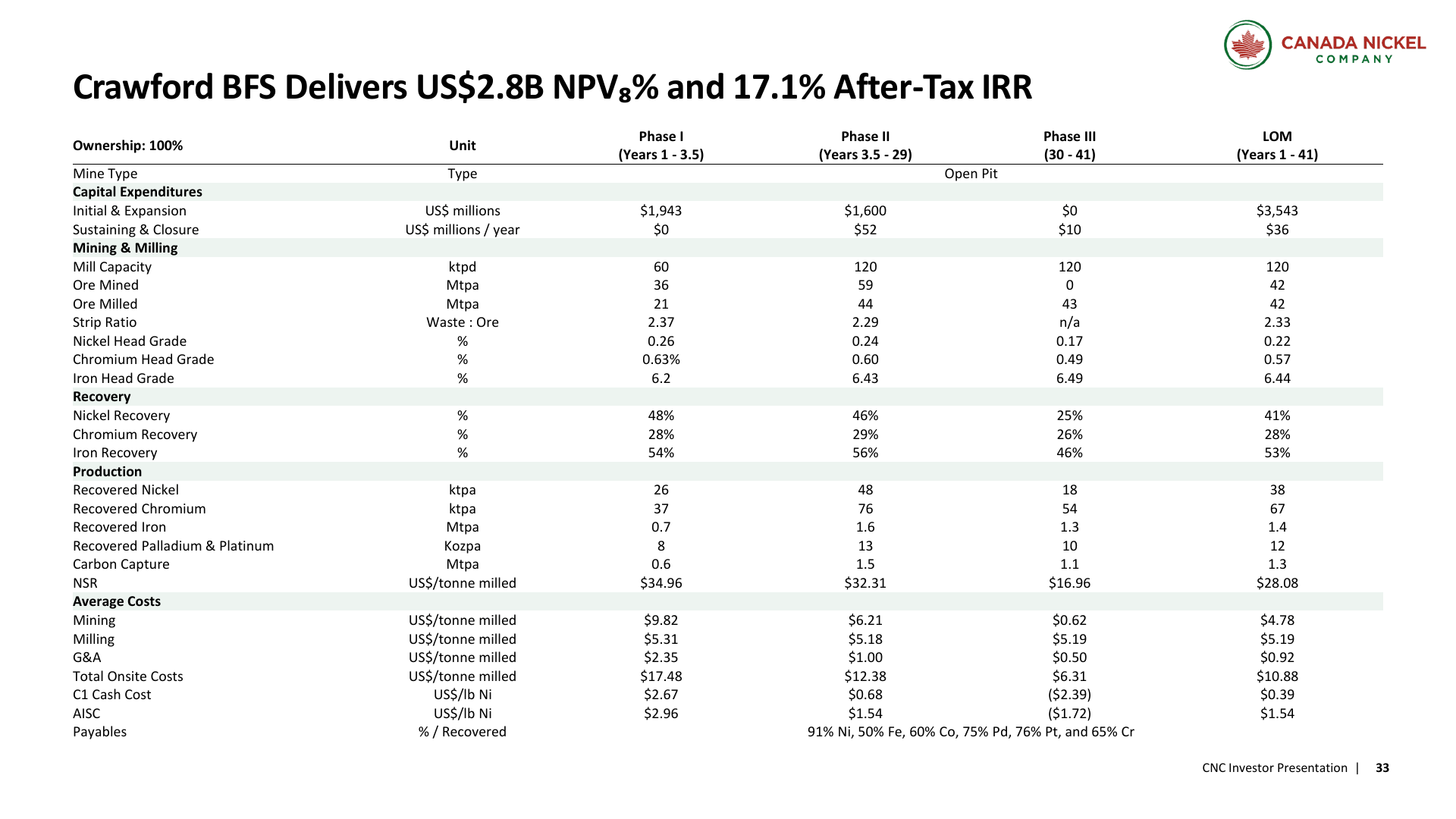
The feasibility study describes a 41-year operation with a two-phase production plan, peak nickel output of roughly 48ktpa and life-of-mine AISC of US$1.54 per pound. Those figures establish engineering scope and modeled economics. Delivered operating performance remains untested.
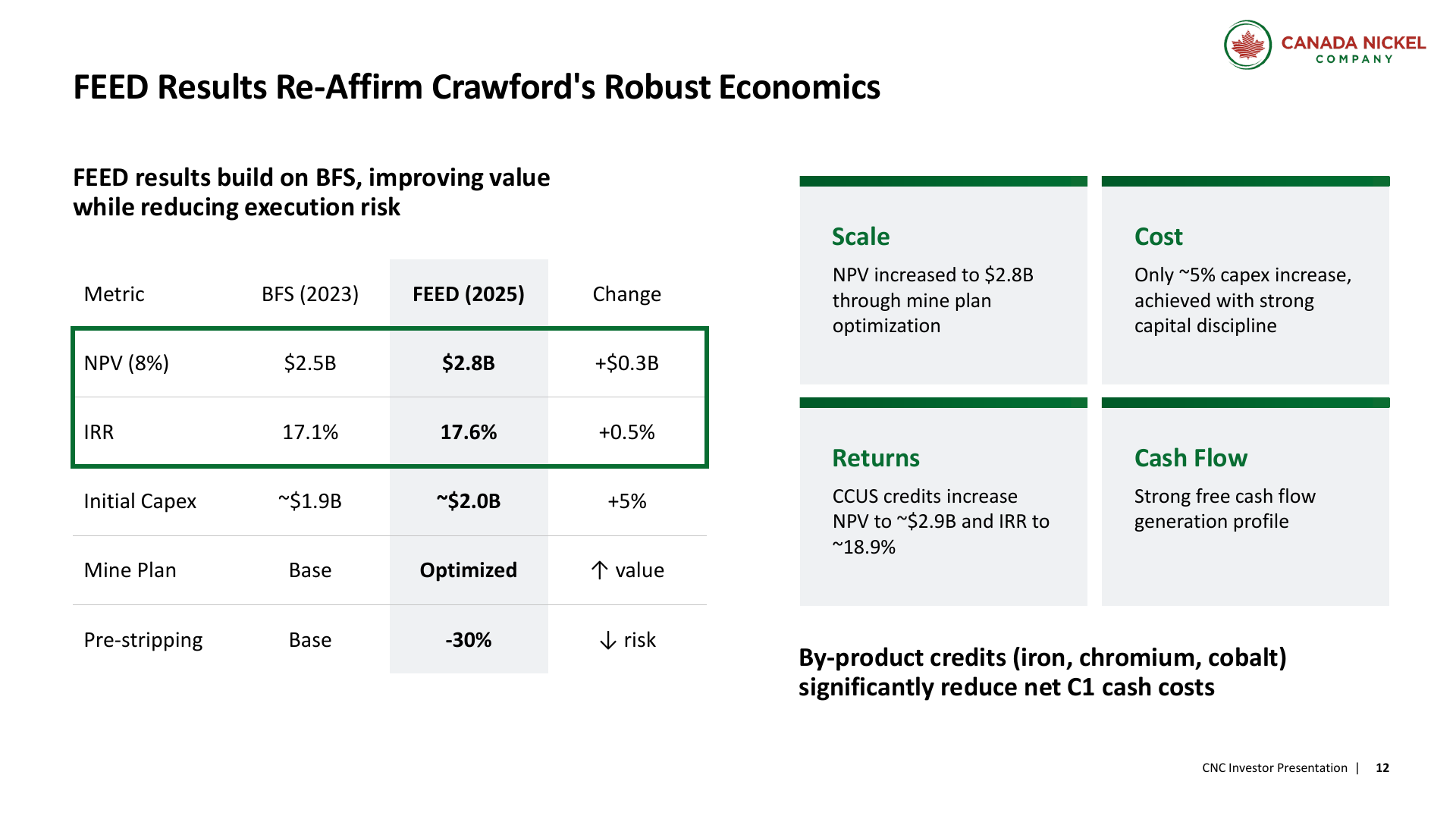
FEED increased the post-tax NPV8 to US$2.8bn and after-tax IRR to 17.6% while initial capex rose to about US$2.0bn. The deck states that expected CCUS credits could lift NPV to about US$2.9bn. We retain US$2.8bn as the base project value and show low-carbon benefits separately.
The project must still complete final permitting, financing, FID, construction and commissioning. The stage factor in our rNAV is the explicit bridge between technical value and current equity value.
Sources: Crawford feasibility study | July 2026 investor presentation
Reserves, Production and Cost
The project is a high-throughput, low-grade system whose economics rely on scale and by-product credits.
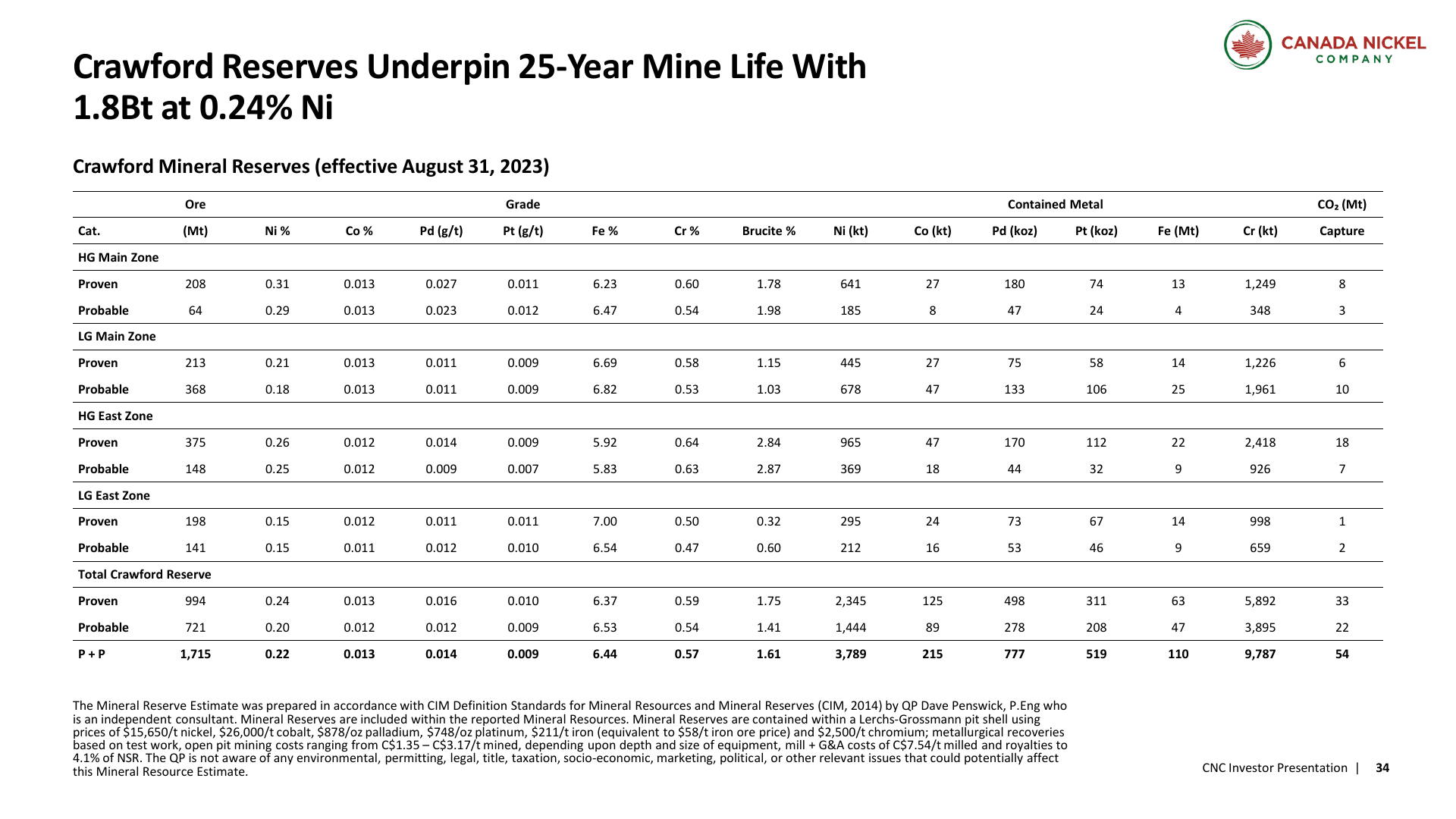
Reserve scale supports the study period
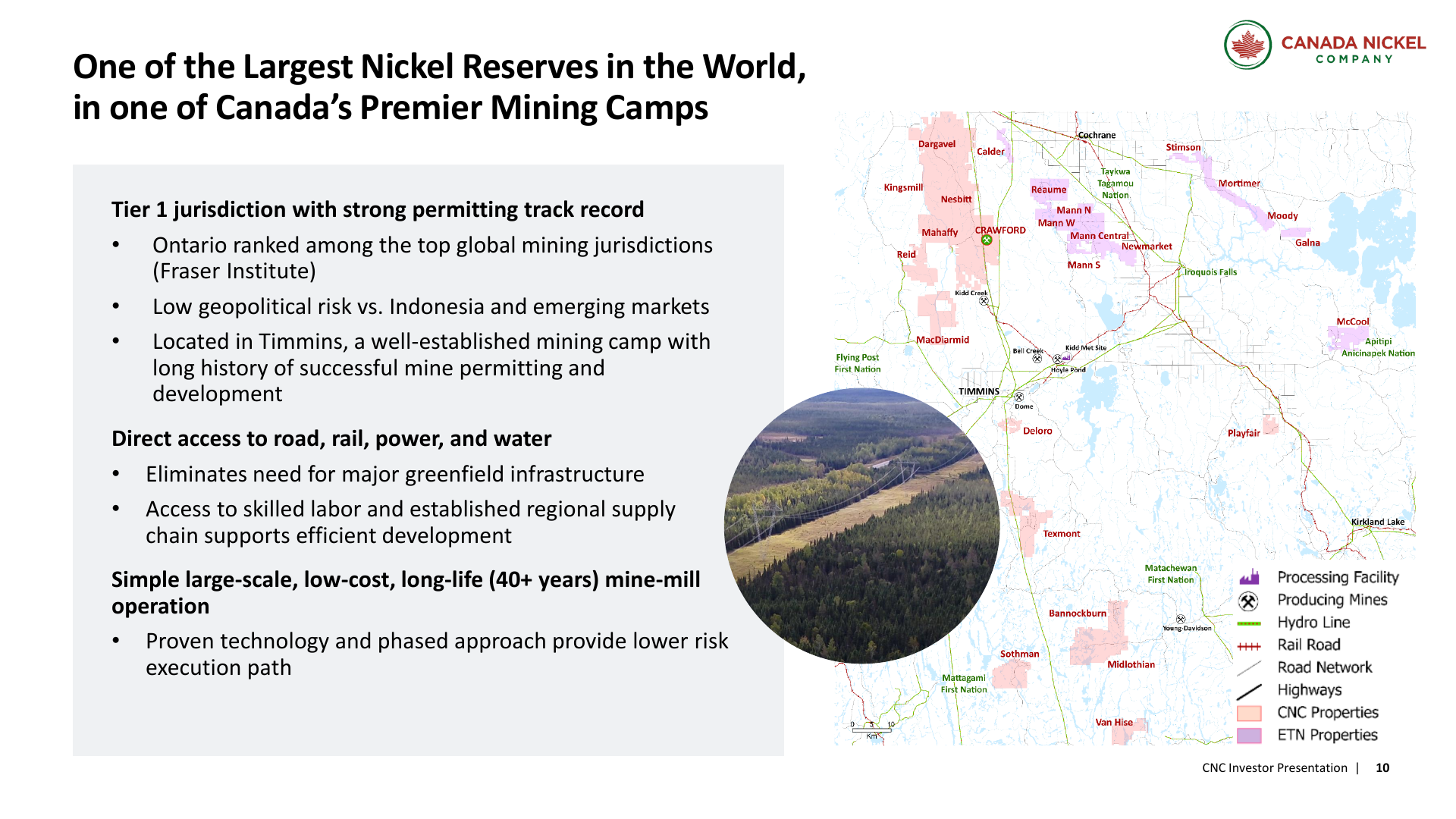
The reserve and mine plan support decades of modeled production. The resource base is unusually large, but grade is low, so throughput, recovery, power, equipment availability and capital discipline matter as much as contained metal.
By-product credits from iron, chromium and cobalt reduce modeled cash cost. Those credits introduce their own price, recovery and market assumptions; they should not be read as a guaranteed offset to nickel weakness.
Our valuation starts with the reviewed project NPV and applies project risk, ownership, FX, net-debt and dilution adjustments. It does not rebuild all 41 years of the mine schedule. The technical study supplies the underlying mine-plan work.
Sources: Crawford feasibility study | July 2026 investor presentation
Project Economics and rNAV
Risking the project NPV is the central valuation judgement.
The valuation bridge
We convert the US$2.8bn post-tax NPV into C$3.90bn using the Bank of Canada USD/CAD observation of 1.3943. We then apply scenario-specific project-stage and effective-ownership factors, subtract C$42m of net debt and divide by 298.9m fully diluted shares.
Base value per share = [(project NPV in CAD x 35% stage factor x 95% effective ownership) - net debt] / fully diluted shares. The formula yields C$4.20 per share. No district, downstream or hydrogen option value is added.
The 35% stage factor is deliberately lower than a post-construction project factor. Federal approval is important. Committed funding, final permits and FID remain unfinished.
Sources: Crawford feasibility study | Bank of Canada FX
| Stage factor | Nickel move | Value/share |
|---|---|---|
| 20% | -10% | C$1.89 |
| 20% | +0% | C$2.34 |
| 20% | +10% | C$2.79 |
| 30% | -10% | C$2.91 |
| 30% | +0% | C$3.58 |
| 30% | +10% | C$4.25 |
| 35% | -10% | C$3.42 |
| 35% | +0% | C$4.20 |
| 35% | +10% | C$4.99 |
| 40% | -10% | C$3.93 |
| 40% | +0% | C$4.82 |
| 40% | +10% | C$5.72 |
| 50% | -10% | C$4.94 |
| 50% | +0% | C$6.06 |
| 50% | +10% | C$7.18 |
Funding and Dilution
Debt availability, government support and common-equity issuance determine how much project value reaches each share.
Financing is the main equity variable
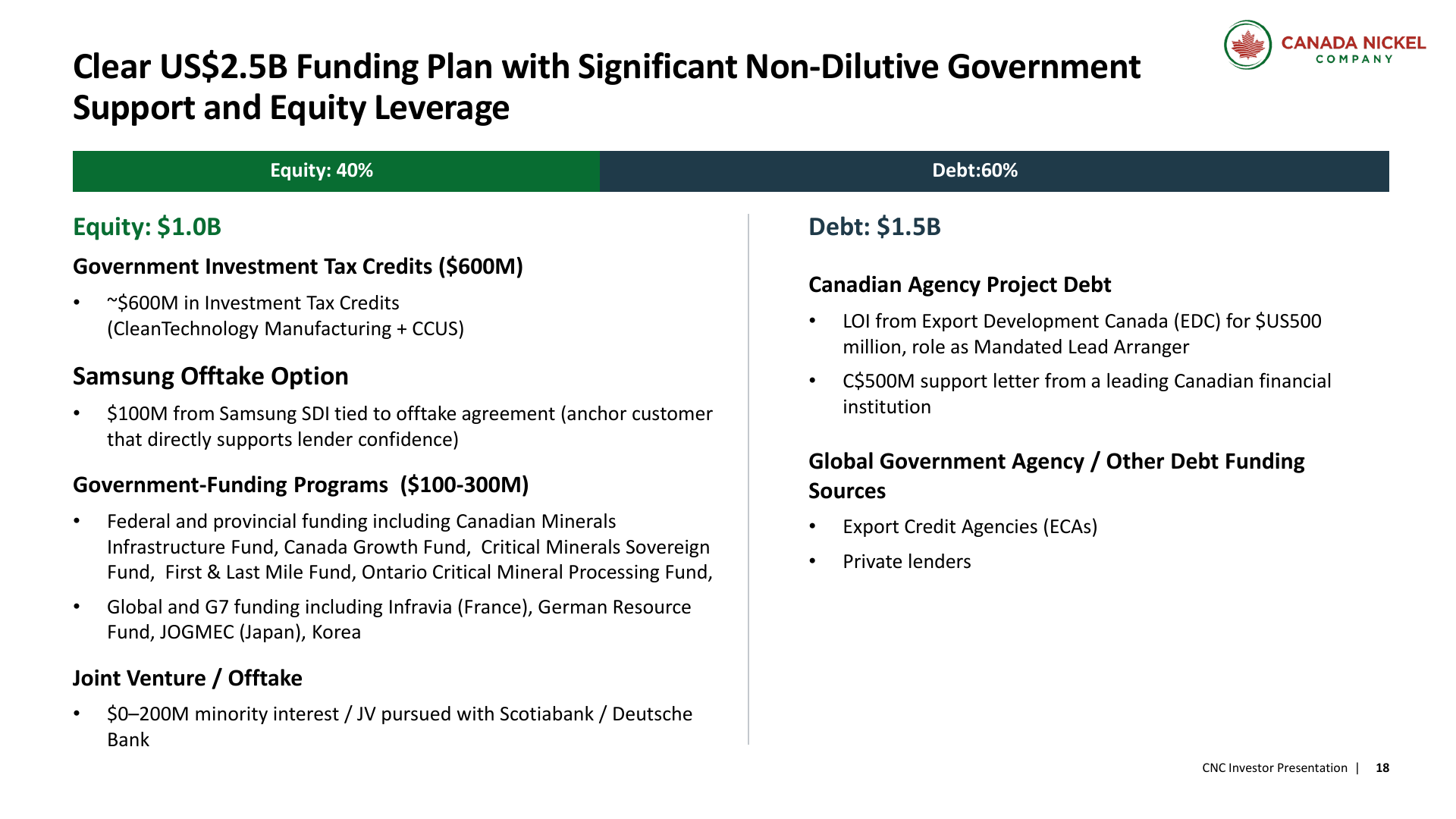
The July deck describes a US$2.5bn funding plan split roughly 40% equity and 60% debt, with investment tax credits, strategic capital, government programs and project debt intended to reduce common-equity dilution.
The EDC mandate for up to US$600m improves financing visibility and remains short of a closed facility. Letters of interest, mandates and support letters show financing progress; construction cash is not yet available.
Our fully diluted share count of 298.9m already captures reported options and warrants. It cannot predict the final financing mix. A more equity-heavy package would reduce per-share value even if project NPV were unchanged.
Sources: July 2026 investor presentation | Q2 2026 financial statements
Permitting and Schedule
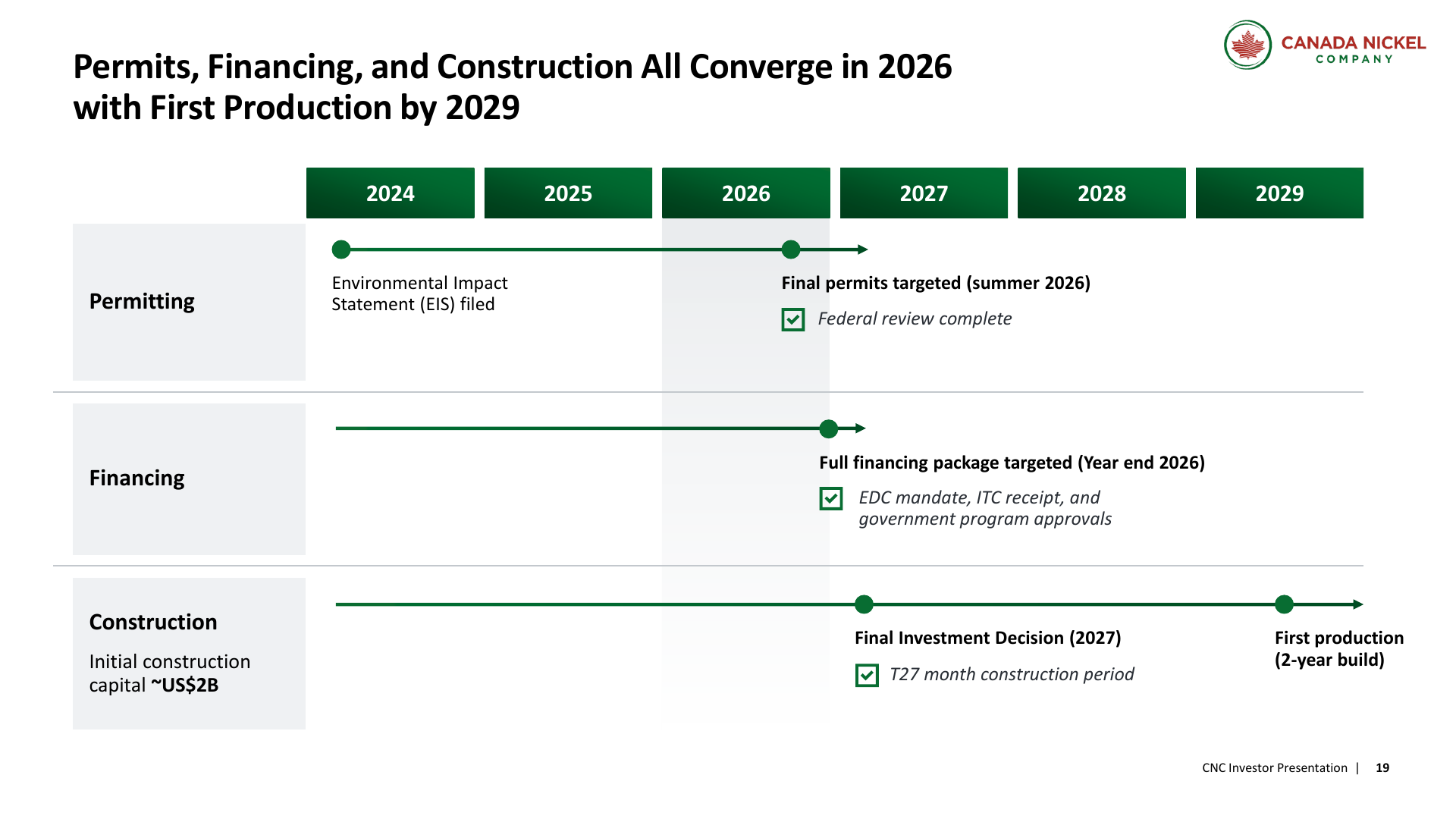
The project now has federal approval, while final permits, financing, FID and construction remain on the critical path.
Federal approval leaves further gates
The federal impact-assessment approval announced on 31 July 2026 is a major de-risking event. Conditions and remaining permits still matter, and the company must align those approvals with financing and engineering readiness.
The current issuer schedule targets FID in 2027, a two-year build and first production in 2029. We do not recognize Revenue before commissioning evidence. A one-year delay would extend corporate cash burn and discount project cash flows for another year.
This is why a permitting headline can change rNAV without changing the next quarter's Revenue or EPS. The event acts through the project-stage factor and schedule confidence; current operations are unchanged.
Sources: Federal approval release | July 2026 investor presentation
Strategic Partners and Offtake
The company has credible strategic relationships with varied contractual status; several do not represent contracted Revenue streams.
Different counterparties solve different problems
Samsung SDI brings strategic capital and an offtake pathway. RWE provides a commercialization channel for low-carbon steel materials. Hydro One addresses electrical connection. EDC supports project debt formation. Agnico Eagle, Anglo American and Taykwa Tagamou Nation participate as strategic shareholders; their role differs from a customer relationship.
The graph keeps these roles separate because their financial transmission differs. An offtake agreement can affect payability and lender confidence; a power agreement affects construction readiness; an equity investor affects governance and funding; a non-binding memorandum provides market validation without booked Revenue.
Counterparty news is collected when it can be tied to one of those mechanisms. General news about Samsung or RWE is excluded unless the article reaches a reviewed Canada Nickel node or end market.
Sources: July 2026 investor presentation | RWE announcement
Timmins District
The district offers substantial geological upside; our base valuation remains Crawford-only.
District optionality remains unvalued
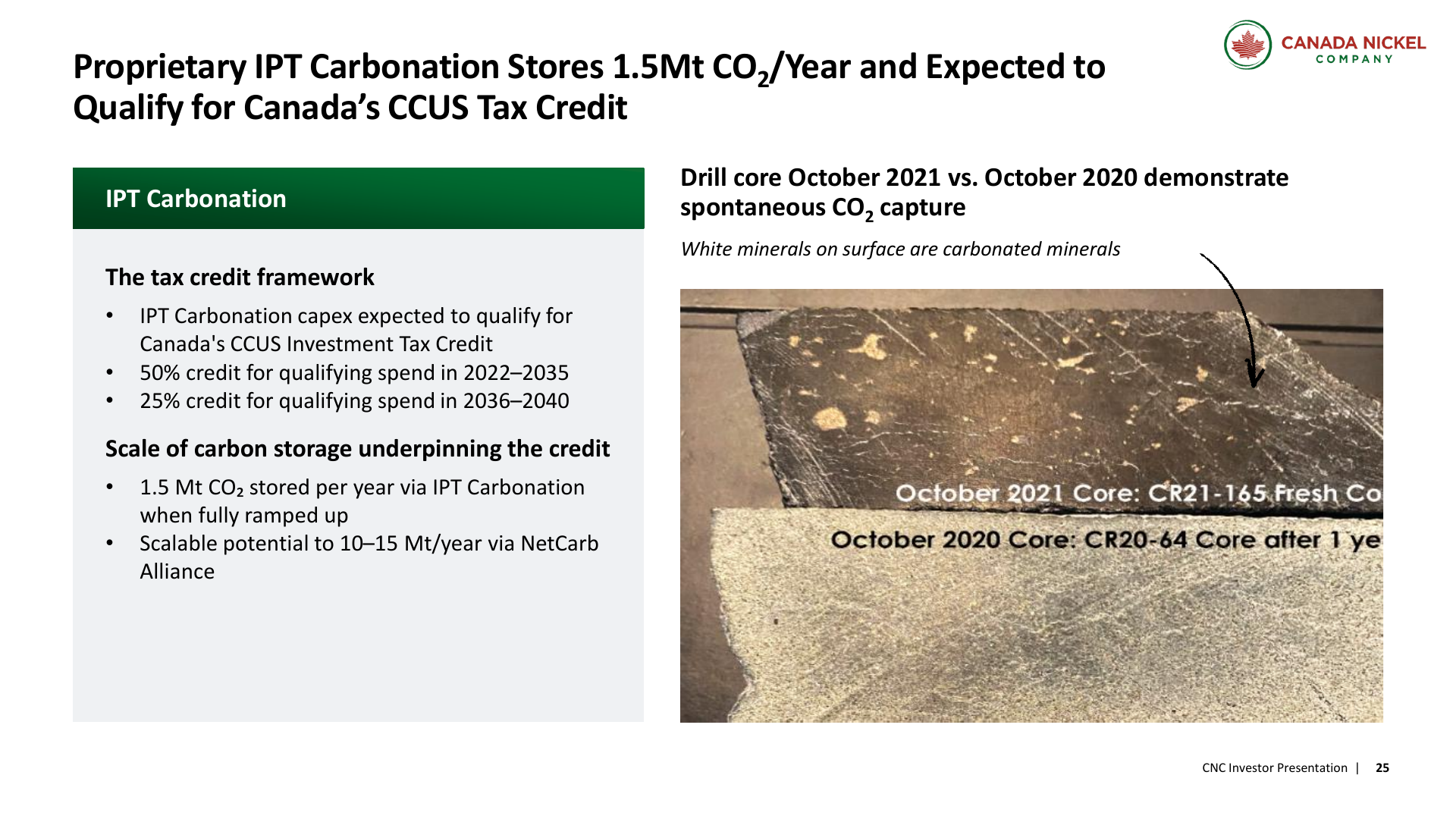
Canada Nickel reports eight resource-stage deposits across the Timmins district and continues to drill Reid and other targets. That breadth can support a future processing and infrastructure cluster.
Exploration success does not automatically become reserve, mine plan, financing or cash flow. We therefore record district drilling as a low-impact monitoring event until a reviewed economic study supports a separate project value.
District optionality remains at zero because no mine plan supports a target-price premium. Without a mine plan, any premium would be an untraceable plug.
Sources: July 2026 investor presentation | Reid update
Carbon Storage and Downstream Optionality
Crawford's low-carbon thesis may support credits and market access; uncontracted premiums remain excluded.
Low-carbon features can improve economics only when monetized
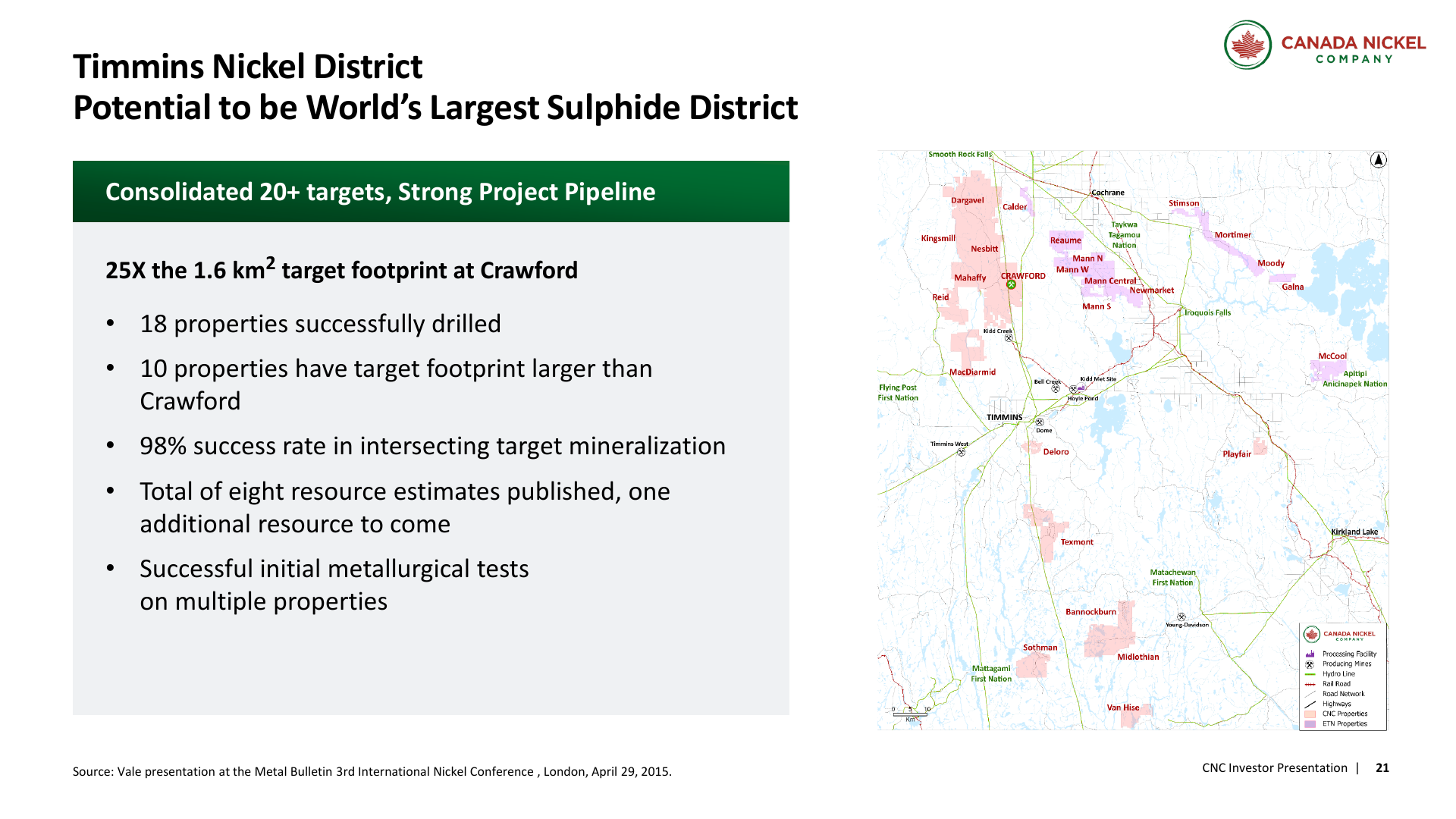
The company is developing in-process tailings carbonation and other carbon-storage pathways. The July deck indicates that expected CCUS credits could increase project NPV from US$2.8bn to roughly US$2.9bn.
We do not add an unsupported green premium for nickel or stainless inputs. Carbon credits enter only through published project economics; downstream facilities and future premium pricing remain outside base value.
The RWE memorandum is useful evidence of customer interest in lower-carbon raw materials. Its non-binding status leaves near-term Revenue unchanged.
Sources: July 2026 investor presentation | RWE announcement
Quarterly Forecast and Model Validation
The near-term model forecasts corporate loss and dilution ahead of first production.
A zero-Revenue gate and a loss-rate control
For FY2026 Q3 we forecast Revenue of C$0 and GAAP diluted EPS of -0.025. The EPS interval is -0.062 to -0.005. FY2026 aggregate net loss is C$26.6m and EPS is -0.108.
Revenue remains zero because the company has no producing mine and first production is targeted for 2029. The loss control uses the mean of the last four reported quarterly net losses. Diluted shares grow at the median recent sequential rate, capped at 5% per quarter.
The selected control was tested on 16 expanding-window periods. Net-income WAPE is 68.6% and EPS SMAPE is 99.3%, so EPS accuracy is weak. The report includes this mechanically derived forecast alongside its weak historical error record.
Sources: Q2 2026 financial statements | Q2 2026 MD&A | July 2026 investor presentation
Valuation
A risk-adjusted project DCF is more appropriate than P/E for a pre-revenue developer.
Bear, base and bull are stage and commodity scenarios
Bear value is C$1.79, base value is C$4.20 and bull value is C$7.57. The cases vary project-stage factor, effective ownership and long-term nickel price. They do not assign probability-weighted value to unstudied assets.
The model-indicated BUY is conditional on the base rNAV and the current reference price. It is not an approved recommendation. A formal rating should also consider liquidity, financing terms, market risk and the analyst's tolerance for pre-development uncertainty.
Valuation risk is best read as a range. The target price can move materially even if quarterly EPS is unchanged because the company's value depends on future project cash flows. Current earnings have limited relevance at this stage.
Sources: Crawford feasibility study | Bank of Canada FX
Events, Catalysts and Transmission Paths
The event layer separates strategic relevance from a quantified change to Revenue, EPS or rNAV.
Events change the mechanism before they change the model
Every accepted event is attached to an evidence source, an affected graph node and a propagation path. The path determines the financial compartment: approval changes stage risk, financing changes debt and dilution, infrastructure changes schedule confidence, and drilling changes geological evidence.
High and medium labels require a bounded forecast or rNAV scenario. Events with no approved model effect remain low impact even when they are strategically interesting. No event is labelled as proven causal.
Market-reaction windows are diagnostic and do not establish causality. The share price may respond to several simultaneous factors, and thinly traded securities can move without a single identifiable catalyst.
Sources: Issuer news releases | July 2026 investor presentation
| Date | Event | Tier | Transmission | Interpretation |
|---|---|---|---|---|
| 31 Jul 2026 | Federal approval | High | Project-stage factor and rNAV | Positive; final permits and FID remain |
| 24 Jun 2026 | EDC debt mandate | High | Funding, dilution and rNAV | Positive process evidence; debt remains uncommitted |
| 9 Mar 2026 | Hydro One agreements | Medium | Construction readiness | Positive infrastructure evidence |
| 6 Jul 2026 | RWE memorandum | Medium | Low-carbon commercialization | Positive validation; no booked Revenue |
| 6 Aug 2026 | Reid drilling | Low | District optionality | No base forecast change |
Risks and Catalysts
The most material risks sit in funding, timing and project execution; the next quarter's Revenue line carries less weight.
The equity case can fail before the orebody does
A large resource and positive feasibility study do not remove financing, schedule, construction or market risk. The company has no operating cash flow to absorb mistakes, so the balance sheet and capital markets remain part of the project system.
The Q2 2026 financial statements report a six-month net loss of C$13.9m and identify going-concern uncertainty. That language is common for a pre-development issuer and economically important because it reinforces reliance on external capital.
The report's target price should be read alongside the bear case and the sensitivity table. A single number cannot capture the range of financing and development outcomes.
Sources: Q2 2026 financial statements | Q2 2026 MD&A | Crawford feasibility study
| ID | Risk | Probability | Impact | Valuation mechanism |
|---|---|---|---|---|
| R1 | Funding and dilution | High | High | A more equity-heavy package lowers value per share even if project NPV holds. |
| R2 | Permitting and schedule | Medium | High | Final permits, FID or construction delays defer cash flow and extend corporate burn. |
| R3 | Nickel price and payability | High | High | A 10% nickel move changes reported NPV by about US$506m. |
| R4 | Capex and execution | Medium | High | A project-cost reset can reduce returns and increase funding need. |
| R5 | Technical and ramp-up | Medium | High | Low grade and scale make recovery, throughput and equipment availability important. |
| R6 | Liquidity and going concern | High | Medium | The Q2 statements identify a working-capital deficit and going-concern uncertainty. |
Methodology, Consensus and Sources
The methodology distinguishes sourced facts, deterministic calculations and analyst judgement.
What is fact, model and judgement
Reported financials, project-study values, dates and relationship evidence are sourced facts. The quarterly loss control and rNAV arithmetic are deterministic model outputs. Stage factors, effective ownership and rating thresholds are analyst judgements.
FMP consensus is used only as an external benchmark. For FY2026 Q3, FMP reports Revenue consensus of C$0 from zero Revenue analysts and EPS of -C$0.00985 from one EPS analyst. Our Revenue is also C$0; our EPS is -C$0.0246, a difference of C$0.0147 per share.
Agreement on zero Revenue reflects the issuer's pre-production status and does not demonstrate forecasting skill. The EPS difference remains material, and the historical EPS error is weak. Those limitations remain in the analysis.
Sources: FMP analyst estimates | Q2 2026 financial statements | Crawford feasibility study
| # | Source | Use |
|---|---|---|
| 1 | Canada Nickel Q2 2026 financial statements | Primary evidence |
| 2 | Canada Nickel Q2 2026 MD&A | Primary evidence |
| 3 | Canada Nickel investor presentation, July 2026 | Primary evidence |
| 4 | FMP analyst estimates | External benchmark |
| 5 | FMP company profile | External benchmark |
| 6 | Crawford NI 43-101 feasibility study | Technical study |